A Mobile Device Developed by VTT Detects Irregular Heartbeats and Helps to Prevent Cerebral Infarctions
- Details
- Category: Development
VTT Technical Research Centre of Finland has developed a mobile app and thumb-size device that help to prevent cerebral infarctions at an early stage, during asymptomatic atrial fibrillation. The mobile device, which detects arrhythmia (irregular heartbeat) has been tested with excellent results for around two years in real-life conditions in cooperation with Turku University Central Hospital.

CHIC Project Survey: Your Opinion Counts
- Details
- Category: Development
The EU-funded CHIC project (Computational Horizons In Cancer: Developing Meta- and Hyper-Multiscale Models and Repositories for In Silico Oncology) proposes the development of clinical trial driven tools, services and secure infrastructure that will support the creation of multiscale cancer hypermodels (integrative models). The latter are defined as choreographies of component models, each one describing a biological process at a characteristic spatiotemporal scale, and of relation models/metamodels defining the relations across scales.
Penn Software Helps to Identify Course of Cancer Metastasis, Tumor 'Evolution'
- Details
- Category: Development
Individual cells within a tumor are not all the same. This may sound like a modern medical truism, but it wasn't very long ago that oncologists assumed that taking a single biopsy from a patient's tumor would be an accurate reflection of the physiological and genetic make-up of the entire mass. Researchers have come to realize that cancer is a disease driven by the same "survival of the fitter" forces that Darwin proposed drove the evolution of life on Earth.
Big Data Europe Addresses Societal Challenges with Data Technologies
- Details
- Category: Development
Across society, from health to agriculture and transport, from energy to climate change and security, practitioners in every discipline recognise the potential of the enormous amounts of data being created every day. The challenge is to capture, manage and process that information to derive meaningful results and make a difference to people's lives. The Big Data Europe project has just released the first public version of its open source platform designed to do just that.
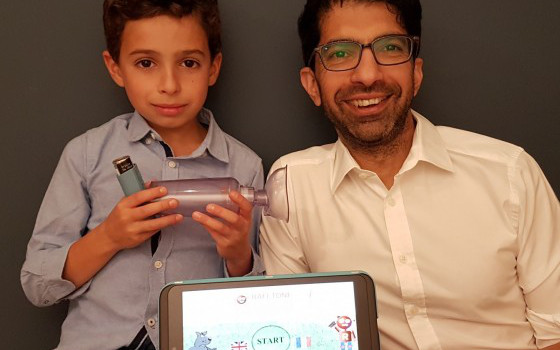
Rafi-tone App Set to Help Millions of Children with Asthma
- Details
- Category: Development
Children with asthma will soon be able to breathe easier thanks to an interactive app created by a University of Manchester spin-out company. The Rafi-tone app, available on i-Phone and Android devices, helps children accept their mask and engage with taking medication by involving them in an onscreen fun animated game.

Super-resolution Microscope Builds 3D Images by Mapping Negative Space
- Details
- Category: Development
Scientists at The University of Texas at Austin have demonstrated a method for making three-dimensional images of structures in biological material under natural conditions at a much higher resolution than other existing methods. The method may help shed light on how cells communicate with one another and provide important insights for engineers working to develop artificial organs such as skin or heart tissue.
Do Pokémon Go and augmented reality games offer real health benefits?
- Details
- Category: Development
The combination of augmented reality technology, geocaching, and other novel techniques to create innovative active video games (AVGs) has potential personal and public health implications, as discussed in the Editorial "Pokémon Go, Go, Go, Gone?" published in Games for Health, a peer-reviewed publication from Mary Ann Liebert, Inc., publishers.
More Digital Health News ...
- Scientists Develop Painless and Inexpensive Microneedle System to Monitor Drugs
- Revealed: 85% not Confident NHS can Hit £22bn Savings Target
- A Painless, Quick and Reliable Method for Diagnosing Helicobacter from Exhaled Air
- Launch of Joint Call for Action to scale up Integrated Care in Europe
- Novel Portable Diagnostic Tool Pairs Optical and Gamma Imaging
- Smartphones and Wearable Devices could Revolutionise Medical Care for People with Brain Disorders
- New Digital Centre to Help Improve Mental Health Care
Page 15 of 46