EU4Health Programme: Regulation (EU) 2021/522 of the European Parliament and of the Council
- Details
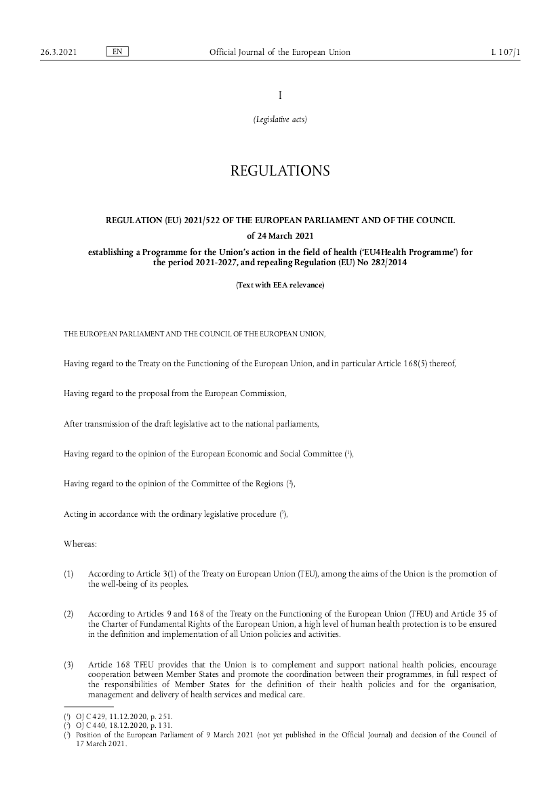 The Programme should be a means of promoting actions in areas where there is a Union added value that can be demonstrated. Such actions should include, inter alia, strengthening the exchange of best practices between Member States, supporting networks for the sharing of knowledge or for mutual learning, addressing cross-border threats to health so as to reduce the risks of such threats and to mitigate their consequences, addressing certain issues relating to the internal market in relation to which the Union can achieve Union-wide high-quality solutions, thereby unlocking the potential of innovation in health, and improving efficiency by avoiding the duplication of activities and optimising the use of financial resources.
 Proposal for a Regulation Laying Down Harmonised Rules on Artificial Intelligence
- Details
 Artificial Intelligence (AI) is a fast evolving family of technologies that can bring a wide array of economic and societal benefits across the entire spectrum of industries and social activities. By improving prediction, optimising operations and resource allocation, and personalising service delivery, the use of artificial intelligence can support socially and environmentally beneficial outcomes and provide key competitive advantages to companies and the European economy. Such action is especially needed in high-impact sectors, including climate change, environment and health, the public sector, finance, mobility, home affairs and agriculture. However, the same elements and techniques that power the socio-economic benefits of
 Artificial Intelligence in MedTech: Delivering on the Promise of Better Healthcare in Europe
- Details
 The medical technology industry welcomes the new European Commission's priority focus on Artificial Intelligence (AI). Our industry sees enormous potential of AI to make healthcare better and safer, improve access and outcomes, empower patients and citizens with information, and make healthcare delivery more efficient.
There are several challenges that impede the deployment of AI in healthcare. These include a fragmented data landscape that makes access to or sharing of data difficult, a lack of interoperability, and a shortage of incentives for data sharing. Legal, technical and social challenges present additional obstacles for the sharing and aggregation of data.
State of Health in the EU: Companion Report 2019
- Details
 Europe is a Union of and for citizens. What matters to Europeans matters to the EU. It should come as no surprise that regular surveys and debates across the continent consistently rank health among the top priorities for European citizens. They are right to expect a high level of protection and it is up to all of us - in all the European capitals - to deliver.
Today, Europe is the region of the world with the highest life expectancy. Yet this progress is slowing down, while inequalities between and within countries are widening. Citizens worry that the lives of their children will be more difficult than their own.
What the Radiologist should Know about Artificial Intelligence - An ESR White Paper
- Details
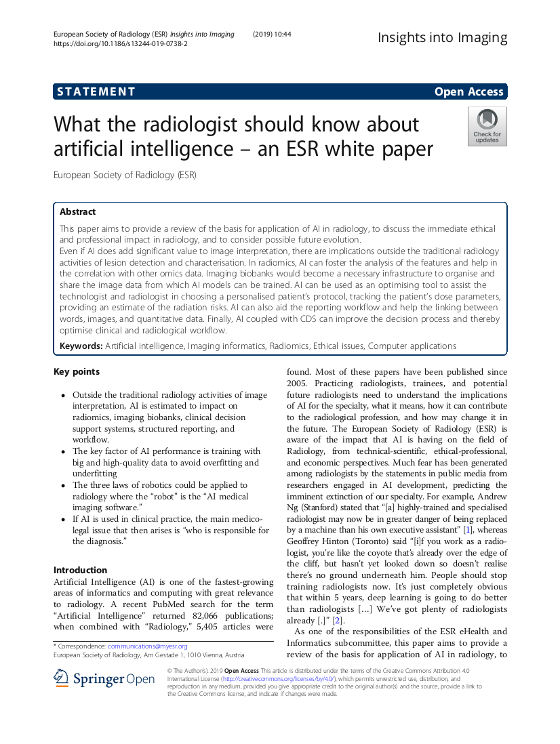 This paper aims to provide a review of the basis for application of AI in radiology, to discuss the immediate ethical and professional impact in radiology, and to consider possible future evolution. Even if AI does add significant value to image interpretation, there are implications outside the traditional radiology activities of lesion detection and characterisation. In radiomics, AI can foster the analysis of the features and help in the correlation with other omics data. Imaging biobanks would become a necessary infrastructure to organise and share the image data from which AI models can be trained. AI can be used as an optimising tool to assist the technologist and radiologist in choosing a personalised patient's protocol, tracking the patient's dose parameters, providing an estimate of the radiation risks.
 WHO Guideline: Recommendations on Digital Interventions for Health System Strengthening
- Details
 Digital health, or the use of digital technologies for health, has become a salient field of practice for employing routine and innovative forms of information and communications technology (ICT) to address health needs. The term digital health is rooted in eHealth, which is defined as "the use of information and communications technology in support of health and health-related fields". Mobile health (mHealth) is a subset of eHealth and is defined as "the use of mobile wireless technologies for health". More recently, the term digital health was introduced as "a broad umbrella term encompassing eHealth (which includes mHealth), as well as emerging areas, such as the use of advanced computing sciences in 'big data', genomics and artificial intelligence".
 Final Report: Provision of a Market Study on Telemedicine
- Details
 The aim of the study is to examine the telemedicine market in Europe and to understand the factors that determine its development. The analysis maps telemedicine applications and solutions, and applicable technical standards and guidelines; it also describes market dynamics and potential barriers limiting wider deployment and uptake of telemedicine solutions. Finally, the study assesses the cost-effectiveness of larger-scale deployment of telemedicine under current and future market conditions, to provide policy makers with advice and considerations for wider deployment of telemedicine.
 More Digital Health News ...
- Health at a Glance: Europe 2018
- Study on Cross-Border Health Services: Enhancing Information Provision to Patients
- AAL Market and Investment Report
- Consultation: Transformation Health and Care in the Digital Single Market
- Life Sciences Report 2017-2018: Biotech-Pharma-Medtech in Berlin-Brandenburg
- Transforming eHealth into a Political and Economic Advantage
- Technology for Health