| Stay updated on the top DIGITAL HEALTH NEWS |
|---|
|
|
Tri-Continental Foundation of Experts, Open Health Tools, Collaborate on Global Health IT Solutions
- Details
- Category: Industry
 Open Health Tools (OHT) today announced a collaborative effort between national health agencies, government-funded organizations and agencies, major healthcare providers, international standards organizations and companies from Australia, Canada, the United Kingdom and the United States to develop common healthcare IT products and services.
eHealth 2008 (UK) - Electronic Healthcare for the 21st Century
- Details
- Category: Events
City University, London EC1
This Conference is organized as a meeting point for telecare product vendors, policy makers, government ministers, academics, clinicians and all those involved in electronic & mobile health, to examine and to share ideas contributing to the advancement of telecare into the 21st century.
eHealthNews.EU Portal Research Project - Invitation for Further Collaboration
- Details
- Category: Download
Article of the Month!
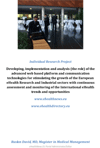 This research project is addressed to all eHealthNews.EU Portal readers interested in strengthening the European eHealth domain. The proposed publication is an open invitation for further collaboration in advancing the European eHealth Research and Industrial sectors. The main project topic is "Identification and analysis of the web based platforms and communication technologies role in stimulating the growth of the European eHealth Research and Industrial sectors with continuous monitoring of the International eHealth trends and opportunities".
Atos Origin Awarded a Further Contract for the Development of the German Electronic Health Card
- Details
- Category: Industry
 Atos Origin, a leading international IT services provider, announced the signing of a five-year contract with the Gesellschaft für Telematikanwendungen der Gesundheitskarte mbH (gematik) for the implementation of the German electronic health card.
Consultation Workshop on Personal Health Systems - Report
- Details
- Category: Download
 This particular consultation workshop is the second of its kind concerning the area of Personal Health Systems (PHS) in the 7th Framework Programme (FP7). The first event was organised in Luzern in February 2006 and provided inputs for the ICT WP of 2007-08. The objective of the current workshop in Tampere was to gather inputs for the ICT WP in the period 2009-2010, as far as the PHS research is concerned.
SAP for Healthcare: Healthcare Providers Industry Overview
- Details
- Category: Download
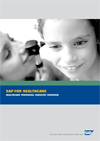 Your industry faces many challenges: improving patient care, controlling costs, meeting government regulations. SAP for Healthcare can help you meet the challenges by streamlining and integrating your healthcare processes administrative and patient-centric on an open, growth-capable platform. Installed in more than 800 organizations, the SAP portfolio allows you to reduce costs and increase the amount of time spent on patient care.
Ascribe Extends Integrated Pharmacy and Robotic IT Systems to Royal Bolton Hospital
- Details
- Category: Industry
 Ascribe plc (AIM:ASP), the innovative health IT Group, today announced that it has successfully installed its Web Pharmacy solution at the Royal Bolton Hospital, part of the Bolton Hospitals NHS Trust and that the site is completely operational. One unique aspect of this 'Go Live' was that, on the same day that the hospital changed its pharmacy IT system, they also brought online a robotic dispensing system; thereby taking a massive leap forward in improving patient care and safety.
National Strategy for eHealth - Sweden
- Details
- Category: Download
 Information and communication technologies (ICT) offer numerous potential benefits in terms of improvements for patients, health and elderly care professionals and decision-makers. Citizens, patients and relatives must have quick, trouble-free access to quality-assured information on health care provision and health concerns, as well as personal data on their own care, treatment and health status. They must also be able to contact care services via the internet for assistance, advice or help with self-treatment.
Smart Clothes: Textiles That Track Your Health
- Details
- Category: Research
Practical Guide to EU Funding for Research, Development & Innovation
- Details
- Category: Research