HYPERImage Project Background Information
- Details
- Category: Research
 Advances in healthcare have been boosted by the constant improvement of medical imaging technologies - for example, in terms of sensitivity and resolution. Magnetic Resonance (MR) imaging, Positron Emission Tomography (PET) and Computed Tomography are now widely used in the diagnosis and staging of many different diseases, including cardiovascular diseases and cancer.
 Cell-on-Chip Biosensor for Detection of Cell-to-Cell Interactions
- Details
- Category: Research
A powerful new biosensor developed by European researchers will help identify cells in the immune system that actively suppress tumour growth, then put them to use. Enlisting the patient's own immune system would be like sending reinforcements for resistance fighters.
EUROPRACTICE Leads the Way in Microchip Design
- Details
- Category: Research
Helped by more than EUR 7 million of Sixth Framework Programme (FP6) and Seventh Framework Programme (FP7) funding, the EUROPRACTICE IC3 and EUROPRACTICE IC4 projects have produced state-of-the-art micromechanical and microelectronic technologies that are being used in universities and industry worldwide to create microchip applications for uses ranging from space technology to medical diagnostics.
Advanced Semantic Knowledge-Based Bio-Medical Search Solution
- Details
- Category: Research
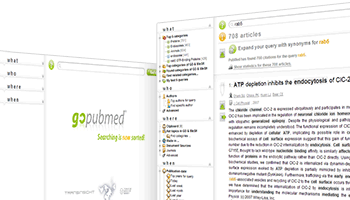 A web browser that can understand technical terms in life sciences and automatically find additional resources and services has been developed by European researchers. It could lead to a new generation of intelligent search engines. The life sciences community has built numerous databases - such as for gene sequencing and information about diseases - that are available to researchers as 'grid' services.
 Smart Integrated Biodiagnostic Systems for Healthcare
- Details
- Category: Research
The SmartHEALTH project is designed to develop and deliver the next generation of smart bio-diagnostic systems capable of being fully integrated into healthcare systems in Europe. Driven by key applications in cancer diagnostics, SmartHEALTH will enable enhanced medical diagnosis leading to earlier and more precise results and thus contributing to an increased quality of life.
Alliance for MRI European Parliament Launch - Time to Deliver for Patients
- Details
- Category: Research
Today two leading MEPs Dr Liese and Stephen Hughes, together with prominent healthcare professionals and leading European patient groups will launch a Parliamentary campaign to safeguard the future use of Magnetic Resonance Imaging (MRI) scanners. These scanners have a proven record and have saved the lives of thousands of cancer, heart and neurological patients.
Google Flu Trends Expands Globaly
- Details
- Category: Research
 Google.org has announced the expansion of Google Flu Trends to 16 additional countries, including Europe. The site now is available in 37 languages and it tracks flu-related search terms as an early predictor of flu trends.
 More Digital Health News ...
- Caalyx Increasing Older People's Autonomy and Self-Confidence
- New Technique Could Spare Cancer Patients from Further Surgery
- Researchers Use Mapping Technology to Tackle Visual Impairment Woes
- IHTSDO and openEHR Begin Collaborative Work Programme
- Spanish Researchers Design Rooms with Sensors that Help Dependent People
- EU Researchers Tackle Borderless Diseases
- British Scientists Use Mould to Create Biological Robot
Page 206 of 269